
Missing teeth change more than your smile. They can affect how you chew, how clearly you speak, and how confident you feel in everyday moments. When patients ask about dentures vs dental bridges, they are usually not looking for the “best” option overall – they want to know which option will work best for their mouth, budget, and long-term plans.
That is the right way to look at it. Dentures and dental bridges can both replace missing teeth well, but they do different jobs, suit different situations, and come with different trade-offs. A good decision starts with understanding how each option works in real life, not just on paper.
Dentures vs dental bridges: the basic difference
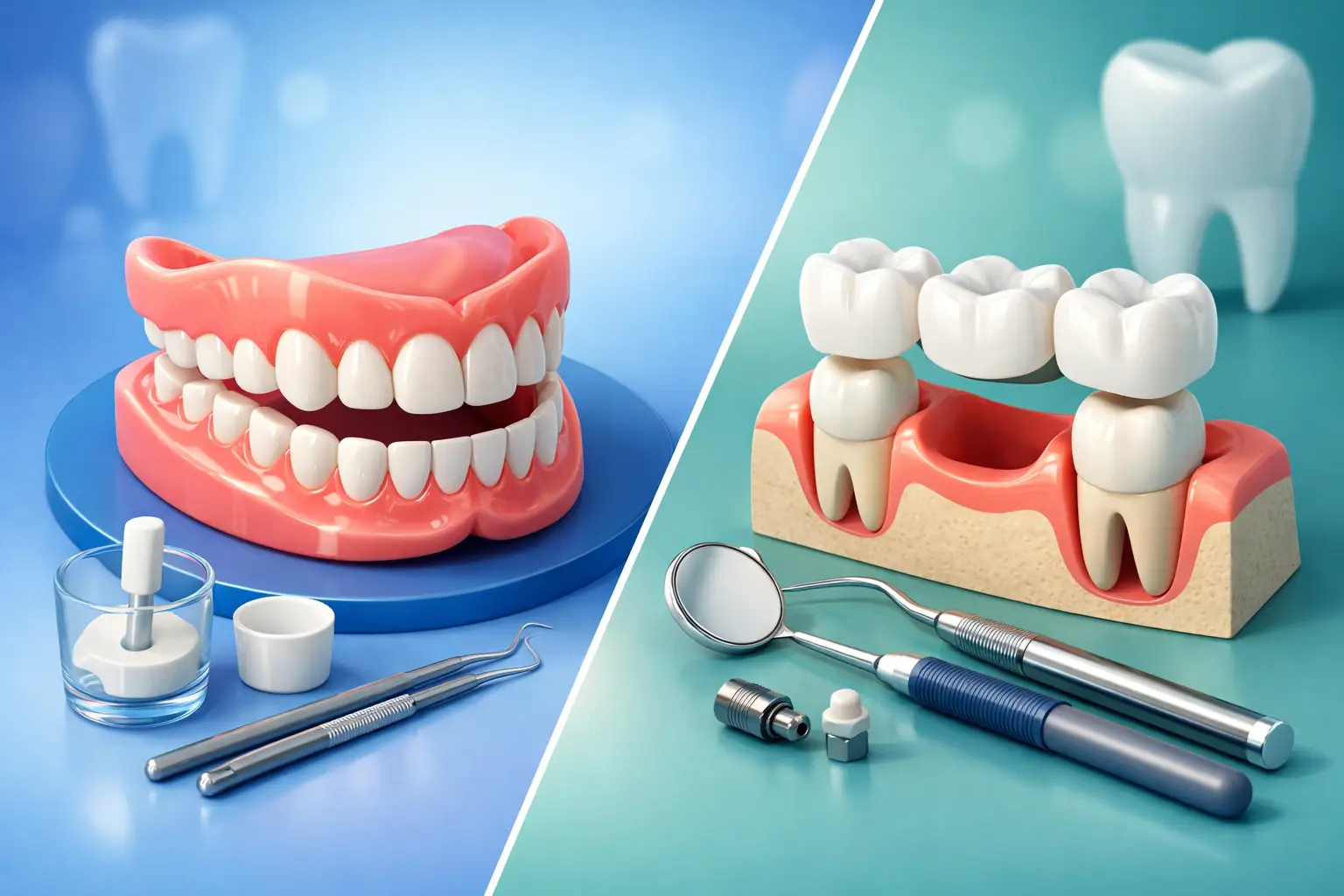
Dentures are removable appliances that replace several missing teeth or a full arch of teeth. Some dentures replace a few teeth and clip around remaining natural teeth, while full dentures sit over the gums when all teeth in the upper or lower arch are missing.
A dental bridge is usually fixed in place. It replaces one or more missing teeth by using the neighbouring teeth for support. The replacement tooth, or teeth, are held between crowns that are attached to the teeth on either side of the gap.
In simple terms, dentures are removable and often used when more teeth are missing. Bridges are fixed and often used for smaller gaps where the surrounding teeth can support the restoration.
When dentures may be the better choice
Dentures are often a practical option when several teeth are missing across different areas of the mouth. They can also be suitable when the supporting teeth are not strong enough or not positioned well enough to carry a bridge.
For some patients, dentures make sense because they are generally a more budget-conscious way to replace multiple missing teeth. If you need to restore a larger section of the mouth, a denture can often do that without the cost involved in several separate fixed restorations.
They can also be a good option when teeth have already been lost and the gums have changed shape over time. In these cases, a well-made denture can restore appearance and function without needing as much work on the remaining natural teeth.
That said, dentures do take an adjustment period. They can feel bulky at first, and some movement is normal, especially with lower dentures. Eating certain foods may require a little practice, and they need to be removed and cleaned daily.
When a dental bridge may be the better choice
A dental bridge is often chosen when one tooth, or a small number of teeth in a row, is missing. Many people like the fact that it stays in place and feels more like natural teeth than a removable appliance.
Because a bridge is fixed, chewing and speaking often feel more stable compared with a denture. Patients who want something that does not need to be taken out at night often prefer this option.
A bridge may also suit someone who already has heavily filled or damaged neighbouring teeth that would benefit from crowns anyway. In that situation, using those teeth to support a bridge can be a sensible restorative plan.
The limitation is that bridges depend on the teeth beside the gap. Those support teeth need to be healthy enough to carry extra load. In many cases, they also need to be prepared so crowns can fit over them. If the adjacent teeth are strong and untouched, some patients are hesitant to alter them.
Comfort and day-to-day feel
Comfort matters more than many people expect. A restoration can look good in the chair but still be frustrating if it does not feel manageable in daily life.
Dentures rest on the gums, so they can create pressure points, particularly while your mouth is getting used to them. Over time, the jawbone and gums can change shape, which may affect fit and require adjustments or relining. A loose denture can rub, trap food, or feel less secure when talking and chewing.
Bridges usually feel more natural because they are fixed and smaller in size. There is no plate covering part of the mouth, and they do not move in the same way a denture can. For many patients, that fixed feeling is the biggest advantage.
Still, comfort is not only about what is fixed and what is removable. A poorly fitting denture can be troublesome, but so can a bridge placed in a bite that is already under strain. The quality of planning matters just as much as the type of treatment.
Appearance and confidence
Both dentures and bridges can improve the look of your smile. The right option depends on where the missing teeth are, how many are missing, and what the surrounding teeth and gums look like.
A bridge often blends very naturally for a single missing tooth, especially in a visible area. Because it is fixed, the tooth position can feel more stable and predictable.
Dentures can also look very natural, especially when carefully designed to support the lips and facial shape. This is particularly important when many teeth are missing, because replacing teeth is only part of the job. The restoration also needs to support the overall shape of the smile.
If appearance is a major priority, your dentist should assess not just the gap itself, but your bite, gum line, speech, and facial support. The most attractive result usually comes from looking at the whole picture.
Cost, maintenance, and long-term value
Cost is a real part of the conversation, and most patients appreciate a clear, honest comparison.
Dentures often have a lower upfront cost than bridges, especially when replacing several teeth. That can make them appealing for patients who need a practical solution sooner rather than later. However, they may need adjustments, relines, or replacement over time as the mouth changes.
Bridges usually cost more initially, but they can offer strong day-to-day function and convenience for the right case. They do require careful cleaning around and under the bridge to protect the supporting teeth and gums. If those teeth develop decay or gum disease, the bridge may be affected too.
So the better value is not always the cheaper treatment at the start. It depends on how long the option is likely to serve you well, how easy it will be for you to maintain, and whether it supports your long-term oral health.
Dentures vs dental bridges for oral health
Replacing missing teeth is not just cosmetic. Gaps can affect your bite, place extra pressure on nearby teeth, and make chewing less efficient. Over time, that can influence comfort and function across the whole mouth.
Dentures can restore chewing to a useful degree, but they do not stop the natural bone changes that happen after teeth are lost. This is one reason dentures may loosen over time.
Bridges help maintain spacing and function, but they rely on the health of the supporting teeth. If those teeth are under too much pressure, or if cleaning is difficult, problems can develop around the bridge.
This is why there is no one-size-fits-all answer. The right restoration should improve function without creating new issues elsewhere.
Who is a good candidate for each?
Dentures may suit you if you are missing many teeth, want a removable option, need a more affordable way to replace several teeth, or do not have enough suitable support for a bridge.
A dental bridge may suit you if you are missing one or a few teeth in the same area, have strong neighbouring teeth, want a fixed option, and are committed to keeping the area very clean.
Sometimes the answer is neither of these alone. Some patients are better suited to implant-based treatment, or to a staged approach that starts with one option and moves to another later. A personalised examination is what turns a general comparison into the right plan for your mouth.
Making the right decision with confidence
If you are weighing up dentures and bridges, try not to focus on one feature in isolation. Comfort, appearance, budget, maintenance, and the health of your remaining teeth all matter. So does your own preference. Some patients strongly prefer something fixed. Others are happy with a removable option if it is practical and cost-conscious.
At Riverina Dental Albury, these conversations are guided by what is likely to work well for you now and over time, not by pushing a single treatment path. A good dentist will explain the pros and cons clearly, answer your questions honestly, and help you choose an option that feels manageable as well as clinically sound.
The best replacement for missing teeth is the one that fits your life, protects your oral health, and helps you smile without second-guessing it.