
Losing a tooth changes more than your smile. It can affect how you chew, how clearly you speak, and even how confident you feel when you laugh or meet someone new. When patients ask about dental implant vs bridge, they are usually not looking for a textbook answer. They want to know what will feel comfortable, what will last, and what makes sense for their mouth and budget.
Both options can replace a missing tooth successfully. The better choice depends on the condition of the surrounding teeth, the health of your gums and jawbone, your timeline, and how you feel about treatment. There is no one-size-fits-all answer, which is why a personalised discussion matters.
Dental implant vs bridge: the basic difference
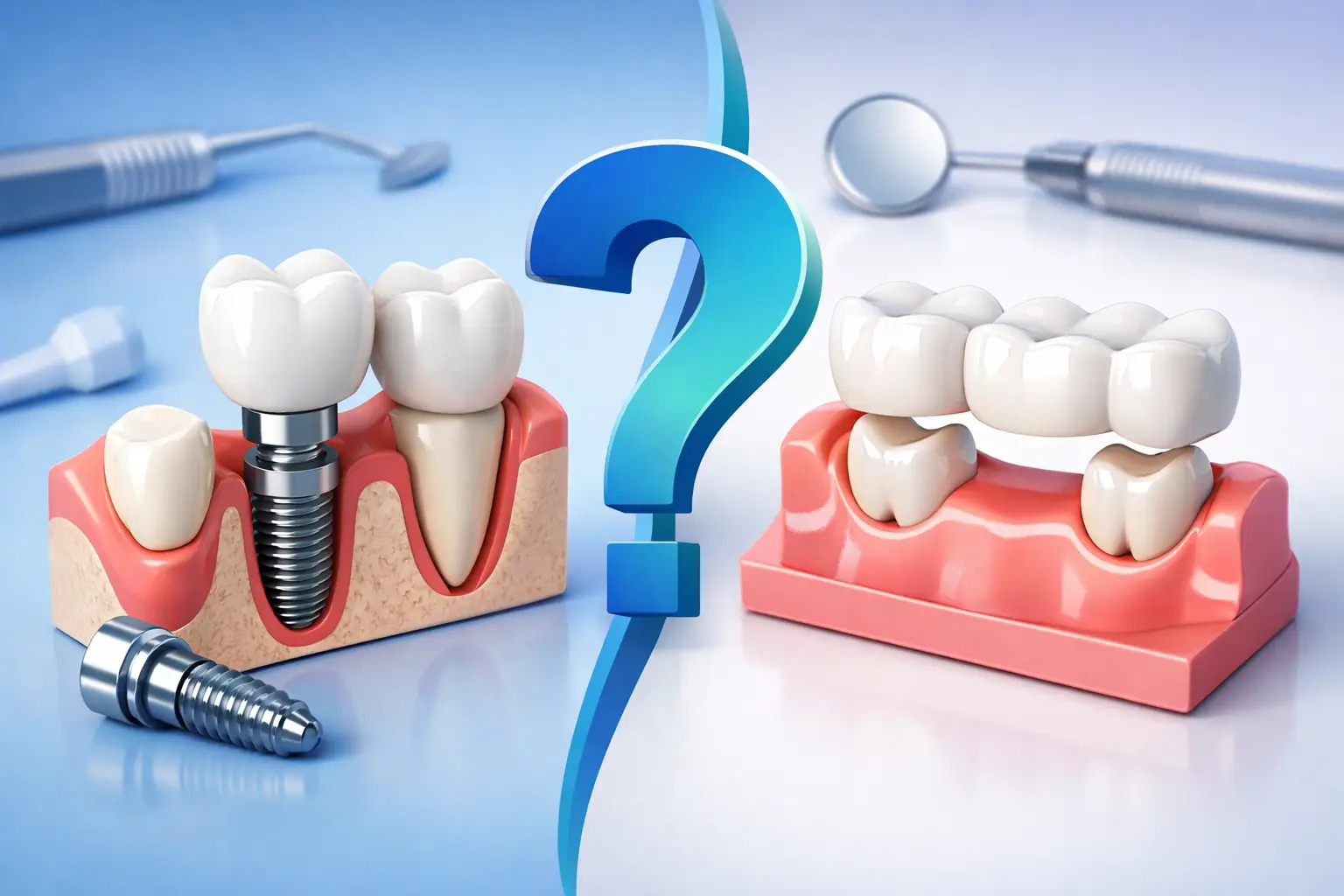
A dental bridge replaces a missing tooth by using the teeth on either side for support. Those neighbouring teeth are prepared, and the bridge is fixed in place to fill the gap. It is a well-established treatment and, in many cases, a very practical solution.
A dental implant replaces the missing tooth root with a titanium post placed into the jawbone. After healing, a crown is attached on top to look and function like a natural tooth. Because the implant stands independently, it does not rely on the next teeth for support.
That difference shapes almost every other part of the decision, from cost and treatment time through to long-term maintenance.
When a bridge may be the better choice
A bridge can be an excellent option when the teeth next to the gap already need crowns or have large fillings. In that situation, using those teeth to support a bridge may make good clinical and financial sense because they need restorative work anyway.
A bridge can also be appealing if you want a quicker treatment timeline. In many cases, the process is more straightforward than implant treatment and does not involve a surgical placement stage. For some patients, especially those who want to restore appearance and chewing sooner, that matters a great deal.
Cost is another common reason people lean towards a bridge. The upfront cost is often lower than an implant, although long-term value depends on how long the restoration lasts and whether other dental work is needed later.
There are situations where a bridge is simply more suitable. If there is not enough bone for an implant, or if certain health factors make implant surgery less ideal, a bridge may provide a reliable alternative. It can also be a sensible choice if you prefer to avoid surgery altogether.
When an implant may be the better choice
An implant is often the closest replacement to a natural tooth because it supports itself within the jaw. That means the neighbouring teeth usually do not need to be drilled down to hold the restoration in place.
For patients with healthy teeth beside the gap, this can be a major advantage. Preserving natural tooth structure is always worth considering, especially when the surrounding teeth are otherwise strong and intact.
Implants also help stimulate the jawbone. When a tooth is lost, the bone in that area can gradually shrink because it no longer has a root to support. A bridge restores the visible tooth, but it does not replace that root function. An implant does, which can help maintain bone in the long run.
Many people also like the feel of an implant. Because it is fixed independently, it can feel very stable when chewing. With good care, implants can last many years and often offer strong long-term value, even if the initial investment is higher.
Dental implant vs bridge for comfort and function
In day-to-day life, both options can look very natural and restore your smile effectively. Most patients adjust well to either one. The finer differences usually come down to how your mouth is built and what kind of restoration it can support best.
A bridge may feel completely comfortable once fitted, but cleaning underneath it requires a little more effort. Special flossing aids or interdental cleaners are often needed to keep the area healthy. If plaque builds up around the supporting teeth, those teeth can become vulnerable over time.
An implant is cleaned more like a natural tooth, although it still requires careful brushing, flossing and regular dental reviews. If gum health is neglected, implant problems can develop too. So while an implant is often seen as lower-maintenance structurally, neither option is maintenance-free.
Chewing function is usually very good with both. If you have multiple missing teeth or bite issues, though, the broader treatment plan becomes more important than the single restoration itself. That is where a thorough assessment can make all the difference.
Cost matters, but so does value
For many households, the real question is not just which treatment is best clinically. It is which one is realistic. That is completely understandable.
A bridge often has a lower upfront cost than an implant. If you need a tooth replaced soon and want an efficient fixed solution, that can be a strong point in its favour. On the other hand, if the supporting teeth later develop decay, fracture, or need further treatment, the total cost over time may change.
An implant usually costs more at the beginning because it involves several stages, including placement and healing before the final crown is fitted. Yet if it remains healthy for many years and helps preserve neighbouring teeth and bone, it may offer better long-term value for some patients.
This is why budget conversations should be honest and pressure-free. Good treatment planning looks at what is ideal, what is possible now, and what can protect your oral health over time.
What about treatment time?
If speed is your top priority, a bridge is often the faster path. Once the supporting teeth are prepared, the final bridge can usually be completed over a shorter period than implant treatment.
An implant takes longer because the jawbone needs time to heal around the implant after placement. That healing period is important for stability and long-term success. In some cases, extra procedures such as bone grafting may add more time.
That longer timeline can feel frustrating if you want the gap sorted quickly. Still, many patients are comfortable waiting if the end result suits their long-term goals better. It comes down to whether you are prioritising speed, tooth preservation, bone support, or a mix of all three.
Who is a good candidate for each option?
A bridge may suit you well if the adjacent teeth already need crowns, if you want a fixed replacement without surgery, or if implant treatment is not ideal due to bone levels, healing concerns or personal preference.
An implant may suit you well if you have healthy gums, enough bone support, good general oral health, and neighbouring teeth that you would rather leave untouched. Non-smokers and patients who can commit to regular maintenance often have the best implant outcomes, although many factors are considered individually.
Gum disease, grinding, medical history and oral hygiene habits all influence the decision. So does the exact location of the missing tooth. A front tooth and a back tooth do not always present the same cosmetic and biting demands.
How dentists decide what is right for you
The best recommendations come from examining the whole picture, not just the gap itself. Your dentist will usually assess the missing tooth site, the health of the teeth either side, your bite, your gum condition and the amount of available bone. X-rays and, in some cases, scans help guide that decision.
Just as importantly, your concerns should shape the plan. Some patients are most worried about appearance. Others want the most conservative option for surrounding teeth. Others need to work within a clear budget or timeline. None of those priorities are wrong.
At Riverina Dental Albury, those conversations are handled with the same goal we bring to all restorative care – clear advice, gentle treatment and options that make sense for your life, not just your X-rays.
The choice is rarely about one tooth alone
When comparing dental implant vs bridge, it helps to think beyond the immediate fix. You are choosing how that area of your mouth will function for years to come. The right answer may be the faster option, the longer-lasting option, or the one that best balances health, comfort and cost.
If you are unsure, that is normal. A good consultation should leave you feeling informed rather than rushed. Once you understand the trade-offs clearly, the decision usually becomes much easier.
Replacing a missing tooth is not only about filling a space. It is about restoring confidence, comfort and the ability to eat and speak without second-guessing yourself. The best option is the one that supports those everyday moments well.