
Losing a tooth can change more than your smile. It can affect how you chew, how clearly you speak, and how confident you feel when you laugh or meet someone new. This guide to replacing missing teeth is here to help you understand your options in plain language, so you can make a decision that suits your health, lifestyle and budget.
For some people, a missing tooth is the result of an accident. For others, it happens slowly through decay, gum disease or years of wear. Whatever the reason, replacing a missing tooth is not just about appearance. Gaps can let nearby teeth drift out of position, place extra pressure on other teeth and make daily eating less comfortable over time.
Why replacing missing teeth matters
When a tooth is lost, the rest of the mouth often has to compensate. You may start chewing more on one side, which can strain the jaw and wear down certain teeth faster. If the missing tooth is toward the front, speech can be affected as well.
There is also the issue of bone loss. The jawbone relies on stimulation from tooth roots. When that stimulation is gone, the bone in that area can gradually shrink. That does not happen overnight, but it can change facial support and make future treatment more complex if you leave the gap for too long.
That said, there is no single right choice for everyone. The best replacement depends on where the tooth is missing, how healthy your gums and jawbone are, how many teeth are involved, and what feels manageable financially.
Your guide to replacing missing teeth: the main options
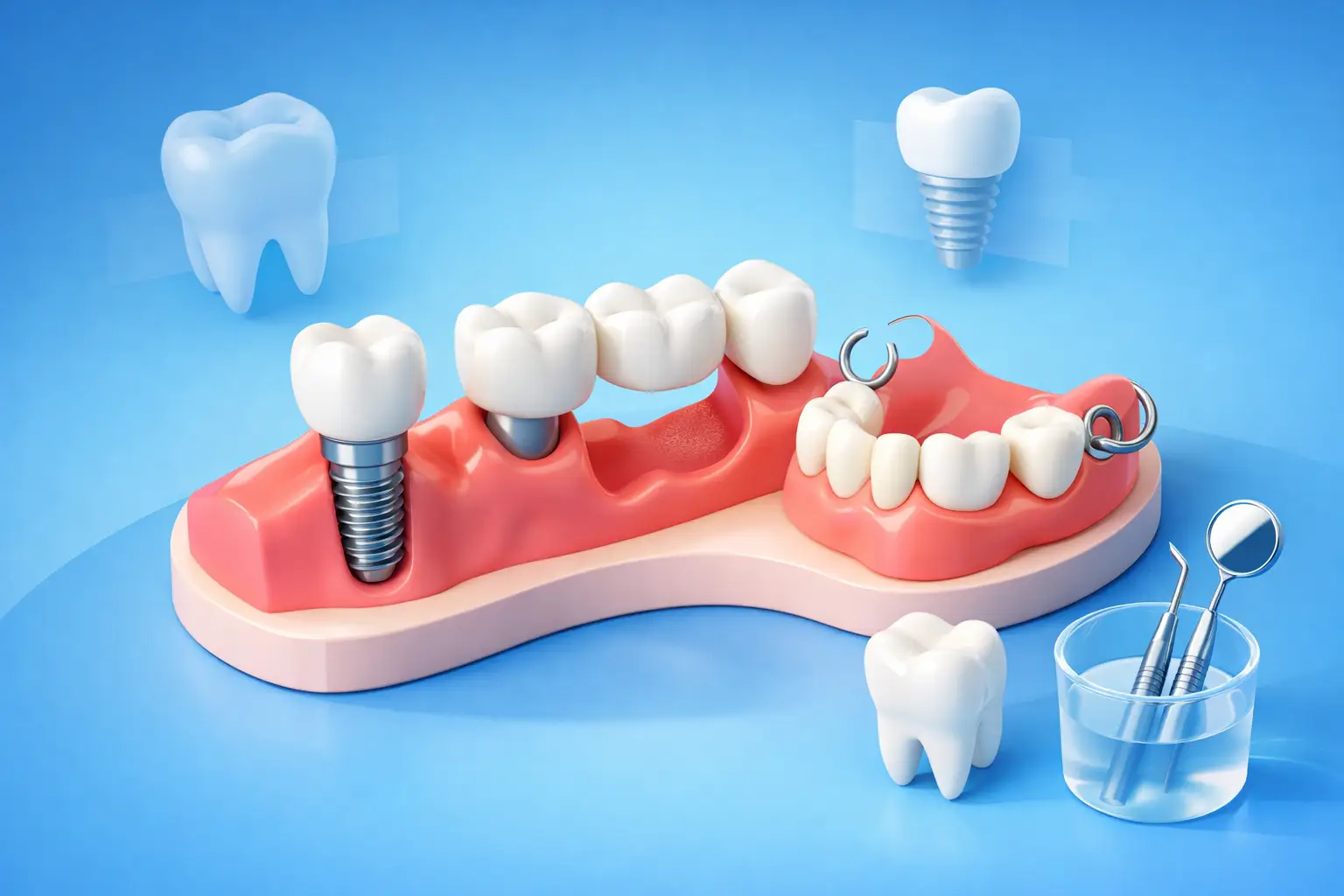
Most patients will be choosing between a dental implant, a bridge or a denture. Each option has strengths, and each comes with trade-offs.
Dental implants
A dental implant is designed to replace the root of a missing tooth. A small titanium post is placed in the jawbone, and once it has healed, a custom-made crown is attached on top.
Implants are often the closest option to a natural tooth in how they look and function. They do not rely on neighbouring teeth for support, and they can help preserve the jawbone in the area. Many people like the stability of an implant because it does not move around when eating or speaking.
The trade-off is that implants are not the quickest or cheapest solution. Treatment takes time, as healing is a key part of the process, and not everyone is immediately suitable. If there is significant bone loss or active gum disease, that may need to be addressed first. Smokers and patients with certain medical conditions may also need more careful assessment.
Dental bridges
A bridge fills the gap by attaching an artificial tooth to the teeth on either side. It is a fixed option, which means it stays in place and is not removed at night.
For some patients, a bridge is a practical middle ground. It can restore appearance and chewing function without surgery, and treatment is usually faster than with an implant. If the neighbouring teeth already have large fillings or need crowns, a bridge can make good clinical sense.
The main consideration is that a traditional bridge usually involves preparing the supporting teeth. In other words, healthy tooth structure may need to be shaped to hold the bridge securely. Bridges also do not replace the tooth root, so they do not provide the same bone support as an implant.
Dentures
Dentures can replace one missing tooth, several missing teeth or a full arch. They can be partial or full, and they are removable.
Modern dentures can look natural and give patients a cost-effective way to restore function, especially when several teeth are missing. For some people, dentures are the most realistic starting point, particularly if they want to replace multiple teeth without a large upfront cost.
The adjustment period matters here. Dentures can take time to get used to, and they may need relining or replacement as the shape of the mouth changes. Some patients find them very manageable, while others prefer a more fixed solution if that is an option.
How to choose the right option
The right treatment is not always the most advanced one. It is the one that fits your mouth, your goals and your circumstances.
If you are missing a single tooth and the surrounding teeth are healthy, an implant is often worth discussing because it can replace that tooth without affecting its neighbours. If you want a fixed result but would rather avoid surgery, a bridge may be more suitable. If several teeth are missing and budget is a major concern, dentures may offer a sensible and effective path forward.
Age alone is not usually the deciding factor. Overall oral health, bone support, gum condition and daily habits matter more. A detailed examination helps identify what is likely to last, not just what looks good in the short term.
Cost, timing and long-term value
Many patients understandably ask about cost first. Replacing missing teeth can be a significant investment, so it helps to think in terms of both upfront cost and long-term value.
Dentures are generally the most affordable initial option. Bridges often sit in the middle, and implants usually involve the highest upfront cost. But cheaper at the start does not always mean cheaper over many years. A solution that needs more maintenance, more frequent replacement or additional treatment later may end up costing more overall.
Timing varies too. A denture can often be provided relatively quickly. A bridge may also be completed within a shorter treatment window. Implants usually take longer because the implant needs time to integrate with the bone before the final crown is fitted.
There can also be staged treatment options. In some cases, a patient may begin with a denture or temporary solution and move to an implant later. This can be useful when budgeting, healing or broader dental work needs to be managed step by step.
Comfort and everyday function
Patients often worry about whether replacement teeth will feel natural. The answer depends on the option chosen and how well it is planned and fitted.
Implants tend to feel the most like natural teeth once treatment is complete. Bridges can also feel secure and familiar because they are fixed in place. Dentures may take more adaptation, especially in the early weeks, but careful design and follow-up adjustments can make a real difference.
Eating comfort matters as well. Softer foods may be easier at first, whatever treatment you choose. Over time, the goal is to restore comfortable chewing and confidence. If you already avoid certain foods because of a missing tooth, that is worth mentioning during your consultation, because it helps guide the treatment plan.
When to act and when it can wait
Not every missing tooth needs to be replaced immediately, but delaying too long can limit your options. Teeth may shift, bone can reduce, and the bite can change. If a front tooth is missing, there may also be social and emotional reasons to act sooner.
In other situations, a short delay is reasonable while infection settles, finances are arranged or other treatment is completed first. What matters is having a plan. Even if you are not ready to start right away, knowing your options early can prevent more complicated problems later.
Questions worth asking at your appointment
A good consultation should leave you feeling clearer, not more overwhelmed. Ask which options are suitable for your mouth now, how long each one is expected to last, what maintenance is involved and what happens if treatment is delayed.
It is also reasonable to ask about comfort, healing time and payment options. A patient-first clinic should be able to explain the pros and cons honestly, without pushing you toward a treatment that does not fit your needs.
At Riverina Dental Albury, this kind of planning is centred on what works for the person in the chair – not a one-size-fits-all answer. Some patients want the longest-term fixed option possible. Others need a gentler, budget-conscious pathway that restores function first and builds from there.
Missing teeth can feel like a big problem, but they are treatable, and you do have options. The most helpful first step is a proper assessment with a dentist who will listen carefully, explain things clearly and help you move forward at a pace that feels right for you.